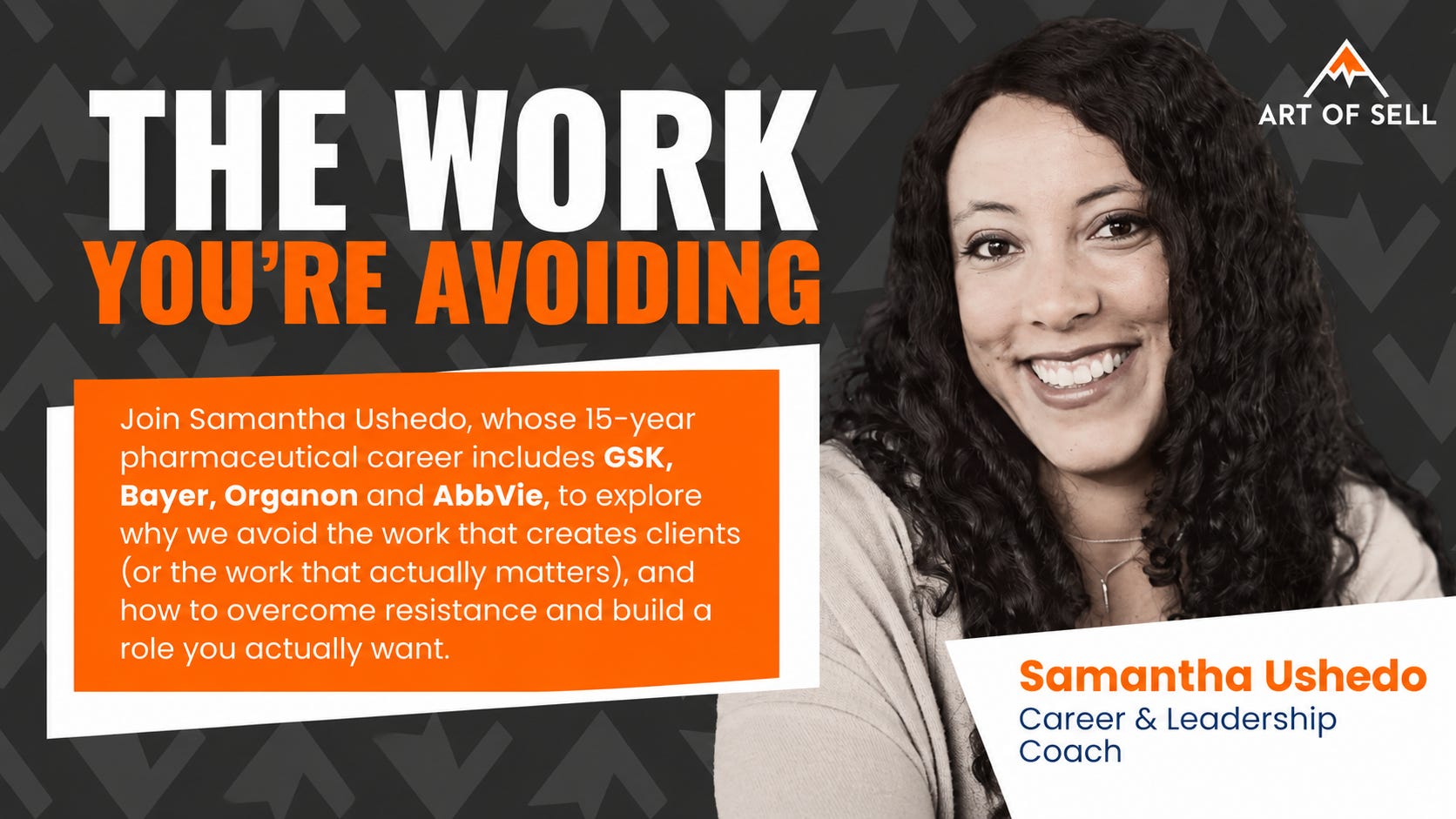
Earlier this week, I delivered a masterclass inside Richard Moore’s Art of Sell community called The Work You’re Avoiding.
The session was designed for founders who were struggling to make time for the activities that actually grow their businesses.
They were busy. They had a million things on their plates. They were working hard.
But some of the most important things weren’t getting done.
And as we worked through why that was happening, we uncovered something that I see all the time with the high-achieving women I coach in corporate careers.
Sometimes the work you’re avoiding is creating the very work you’re overwhelmed by.
Let me explain.
You’re not afraid of hard work
If anything, you’re probably doing too much of it.
You’re the person people can count on. You take pride in your work. You care about doing a good job.
You’ve spent years building your career, developing your expertise, and earning the trust of the people around you.
You’re not someone who shies away from responsibility.
In fact, that’s probably part of the problem.
When someone needs help, you make time.
When a deadline moves up, you figure it out.
When something isn’t done to your standards, you fix it.
When your workload gets overwhelming, you work a little longer.
And because you’re capable of handling so much, you keep handling it. Except lately, you’re exhausted.
Your workday doesn’t seem to have an end. Even when you’ve closed your laptop, you’re still thinking about what you need to do tomorrow.
You keep telling yourself that once this project is finished, once things settle down, once you get through this particularly busy period, you’ll have more time for yourself.
But that time never seems to come. So you start looking for ways to become more efficient.
A better system. A new planner. Another productivity hack.
And maybe some of those things will help.
But I want you to consider something else.
What if the solution to your workload isn’t becoming better at doing everything? What if it’s finally doing the things you’ve been avoiding?
The things you’re avoiding might surprise you
When I asked the founders in my masterclass what wasn’t working in their businesses, they had plenty of answers.
They weren’t doing enough outreach. They weren’t following up consistently. They weren’t making enough offers. But as we dug deeper, it became clear that knowing what to do and actually doing it were two very different things.
And the same thing happens at work.
Think about some of the things you might be putting off.
Having a conversation with your manager about your workload.
Telling someone you don’t have capacity to take on another project.
Giving a colleague feedback about work that isn’t meeting expectations.
Delegating something you’ve been doing yourself for years.
Letting someone be disappointed because you can’t accommodate their request.
Submitting work that’s good enough instead of spending another three hours perfecting it.
Leaving work at the time you said you would, even though there’s still something left on your list.
None of those things is particularly complicated in theory. You probably know how to do most of them.
So why aren’t you?
Sometimes it’s not the task you’re avoiding. It’s the feeling.
One of the foundational tools I use in my coaching practice is called the Model.
It helps us examine the relationship between five things:
Circumstances: The facts of a situation.
Thoughts: What we think or believe about those circumstances.
Feelings: The emotions we experience.
Actions: What we do or don’t do.
Results: What happens as a consequence of those actions.
It’s useful because we often focus on changing our actions without understanding what’s influencing them.
Let’s walk through an example.
Your manager asks you to take on another project, but your workload is already full.
You think:
If I tell her I don’t have capacity, she’ll think I can’t handle my job.
That thought makes you feel anxious. So instead of having an uncomfortable conversation about priorities, you say yes. You figure you’ll make it work.
Maybe you work through lunch. Maybe you stay late. Maybe you sacrifice part of your weekend.
And now you’re even more overwhelmed than you were before. The result?
You’ve reinforced your belief that you have too much work and not enough time.
But look at what happened.
You didn’t necessarily say yes because you had capacity. You said yes because you wanted to avoid the discomfort of saying no. And now you’re paying for that decision with your time and energy.
The same pattern can show up in so many different ways.
You’re avoiding disappointing people, so you keep disappointing yourself
Let’s say you’ve made a commitment to finish work at 6 p.m. because you want to get back to exercising regularly and you’ve booked a class at 7pm.
At 5:45pm, a colleague messages asking for help with something. You could tell them you’ll look at it tomorrow.
But you start thinking:
They need my help.
It’ll only take a few minutes.
I don’t want to be difficult.
What if they think I’m not a team player?
So you respond. And what was supposed to take five minutes takes forty-five. Now you’re late leaving work. You’re tired. You miss your workout.
Again.
You’re disappointed, but you tell yourself you’ll try harder tomorrow. Except the problem wasn’t that you didn’t try hard enough. The problem was that you weren’t willing to experience the discomfort of letting someone wait.
And every time you avoid that discomfort, you make another decision about whose priorities matter more.
You’re avoiding criticism, so you keep perfecting everything
Maybe you’re working on a presentation.
It’s good. You’ve addressed the important points. The information is accurate. It does what it needs to do. But you keep tweaking it.
You rewrite the introduction.
You change the formatting.
You add another slide.
You review it one more time.
Why?
Maybe you’re thinking:
What if someone finds a mistake?
What if my boss doesn’t think it’s good enough?
What if people think I don’t know what I’m doing?
Those thoughts generate anxiety or insecurity. So you keep working.
Not necessarily because the presentation needs more work, but because continuing to work allows you to delay the moment when someone else gets to evaluate it.
And now something that could have taken two hours has taken five.
You’ve created more work in an attempt to avoid feeling uncomfortable.
The problem isn’t always that you don’t know what to do
I think this is an important distinction. Sometimes you genuinely need more information, a new skill, or a better strategy.
If you don’t know how to delegate effectively, learning how to do that is useful.
If you struggle to communicate with your manager, developing those skills matters.
But there’s a difference between identifying a specific gap you need to address and telling yourself you need more information because you’re uncomfortable taking action.
During the Q&A of my masterclass, someone asked a great question:
How do you distinguish between resistance and genuinely not being ready?
My response was to get specific.
If you think you need more information, what information do you actually need?
What skill do you need to develop?
What question needs answering?
And what action can you take to move forward?
Because there’s a big difference between actively learning something and endlessly telling yourself you’re not ready.
The same applies to changing how you work.
You can spend months reading about boundaries.
You can listen to podcasts about people pleasing.
You can save every Instagram post about burnout.
But eventually, you’re going to have to do something differently. And it’s probably going to feel uncomfortable.
You don’t need to eliminate the discomfort before taking action
This was one of the biggest lessons I wanted the founders to leave my session understanding.
We spend so much time trying to feel better before we act.
We tell ourselves we’ll have the conversation when we feel more confident.
We’ll set the boundary when we stop feeling guilty.
We’ll delegate when we feel comfortable letting go of control.
But what if you never feel completely comfortable?
What if guilt shows up every time you tell someone no?
What if you’re anxious the first ten times you have a conversation about your capacity?
What if allowing someone else to do something differently still makes you want to jump in and fix it?
You can feel uncomfortable and take action anyway.
You can feel guilty and maintain your boundary.
You can feel anxious and communicate your needs.
You can feel uncertain and make a decision.
You can feel disappointed in the outcome and still recognize that taking action was the right thing to do.
I sometimes tell my clients that you need to be willing to gag and go, a phrase I learned from my coach, Olivia Vizachero.
Not because I want you to force yourself through every difficult thing in your life, but because sometimes the only thing standing between you and meaningful change is an uncomfortable feeling you’re unwilling to experience.
Feelings aren’t instructions. You don’t have to obey every one of them.
But allowing discomfort is part of taking action.
You’re choosing discomfort either way
Here’s something I really want you to consider.
Avoiding the uncomfortable thing doesn’t mean you’re avoiding discomfort. You’re just choosing a different kind.
You can experience the discomfort of telling your boss you don’t have capacity.
Or you can experience the discomfort of working another weekend.
You can experience the discomfort of delegating something and allowing someone else to do it differently.
Or you can experience the exhaustion of doing everything yourself.
You can experience the discomfort of letting someone be disappointed.
Or you can experience the resentment of constantly putting your own needs last.
You can experience the discomfort of leaving work unfinished.
Or you can experience another evening where you don’t have time or energy for anything outside your job.
There is discomfort on both sides.
Which one are you willing to experience in service of the life you actually want?
Because if you keep choosing the discomfort you already know, you may keep getting the results you already have.
An exercise for your next workweek
I want you to think about one thing you’ve been avoiding at work.
Not ten things. Just one.
Maybe it’s a conversation.
A decision.
A boundary.
Something you’ve been meaning to delegate.
Something you know you need to stop doing.
Now ask yourself:
1. What am I actually avoiding?
Be specific about the action. Not “I need to set better boundaries.”
Maybe it’s “I need to tell my manager that if this new project is the priority, we need to agree on which existing deliverable moves.”
2. What am I afraid will happen if I do it?
Write down the thoughts that come up. Don’t filter them.
Maybe you’ll think someone will be disappointed.
Maybe you’ll worry about being perceived as incapable.
Maybe you’ll worry that you’re jeopardizing the career you’ve worked so hard to build.
3. What would I have to be willing to feel to take the action anyway?
Guilt?
Anxiety?
Uncertainty?
Embarrassment?
Disappointment?
Name the feeling. Then make a decision about whether you’re willing to experience it. And finally, take one action.
You don’t need to overhaul your entire working life overnight. But you do need to start creating evidence that you can do things differently.
Afterward, evaluate:
What worked?
What didn’t?
What will I do differently next time?
Because clarity isn’t always something you get before you act. Sometimes you create it by taking action, seeing what happens, and learning from the experience.
You worked hard to build your career. You shouldn’t have to sacrifice your life to sustain it.
I know how much your career matters to you. I know you don’t want to jeopardize everything you’ve worked for.
And I’m not suggesting that every difficult situation can be solved by setting a boundary or changing your thoughts.
Sometimes the expectations are genuinely unreasonable. Sometimes the environment needs to change. Sometimes leaving is the right decision.
But before assuming your only options are to keep working this way or walk away from your career, I want you to consider what might be possible if you started changing how you work.
Because you might discover that some of the things you thought were requirements of your job were actually expectations you placed on yourself.
And you might discover that some of the work you’re avoiding is exactly what would allow you to stop working so much.
You don’t need to care less about your career.
You need to become more intentional about what deserves your time, energy, and attention.
And sometimes that means being willing to do the uncomfortable thing now so you can stop paying for avoiding it later.
Ready to change the way you work?
We’ve talked about the work you’re avoiding.
But there’s another side to this conversation.
What about all the work you’re doing that you don’t actually need to be doing?
The responsibilities you’ve taken on.
The expectations you’ve created for yourself.
The time you spend overthinking, overpreparing, and managing other people’s reactions.
The work that follows you home, even after you’ve closed your laptop.
On November 7, I’m hosting a live workshop inside the Intentional Ambition Collective called The Way You Work Is the Problem.
We’re going to take a closer look at your actual workload, identify where you’re creating unnecessary work and stress, and examine the high-achiever habits that may be making your career harder than it needs to be.
You’ll start identifying what needs to change so you can continue succeeding professionally without sacrificing yourself in the process.
Because the goal isn’t just to make a living.
It’s to make a life.
Join the Intentional Ambition Collective and attend the November 7 workshop.
I’d love to have you there!
- Samantha